


I haven’t really posted on the Substack in awhile. Many of the topics I usually write about here — from the Middle East to the Arctic to the Freedom of Information Act — I’ve been busy covering at Reason. Do read my coverage there. But I wanted to share some thoughts on a lighthearted topic here.
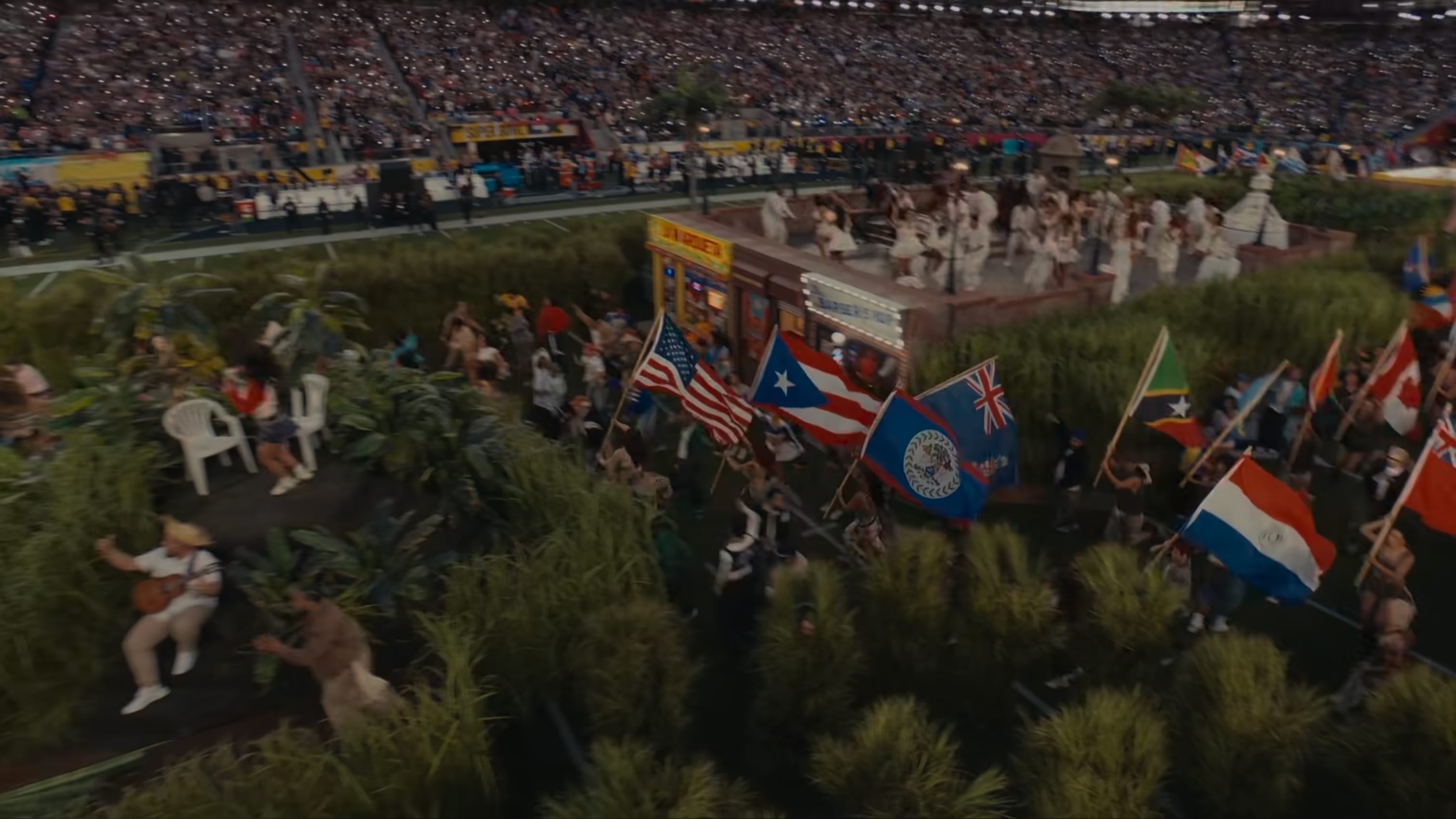
There’s a joke that to a foreigner, a “Yankee” is an American; to an American, a “Yankee” is a Northerner; to a Northerner, a “Yankee” is a New Englander; and to a New Englander, a “Yankee” is someone who eats apple pie for breakfast. The opposite is true for the term “America.” It grows with proximity.
To a foreigner, a “America” is the United States of America, the nation between Canada and Mexico. But to people in the neighborhood, “América” is the whole supercontinent. Canada and Mexico are American nations, as is everyone else in the Western Hemisphere.
The musician Bad Bunny’s halftime show at the Super Bowl was an ode to pan-Americanism. Although it wasn’t particularly subtle — he sings “God bless America, be it Chile, Argentina, Paraguay, Uruguay…” while leading a parade of flags — the history might be lost a little on foreigners. Or people from the United States, for that matter.
Bad Bunny himself comes from a place with a bit of a strange relation to being “American.” Puerto Rico, conquered by the United States in 1898, has never tasted independence. Its people are U.S. citizens, but their territory is not one of the United States, and therefore they do not have a say in the way the country is run.
Bad Bunny is part of the small but growing independence movement in Puerto Rico. His song “Lo Que Le Pasó a Hawaii,” performed by Ricky Martin at the halftime show, warns Puerto Ricans not to let themselves go the way of the ethnic Hawaiians, a conquered and assimilated culture.
His frequent collaborator, Residente, is much more explicit in these politics. And Residente leans into pan-Americanism alongside his Puerto Rican nationalism. His song “This Is Not America,” which I’ve cited before on this blog, lays into the two meanings of the phrase. Puerto Rico is not the United States, in his view, and the United States is not “America.” The music video starts out with the Puerto Rican guerrilla attack on Washington in 1954, and against the backdrop of imperialist crimes, Residente sings:
America is not just the USA, papa
It’s from the Tierra del Fuego up to Canada,
You have to be such a brute, so empty-headed,
It’s like saying that Africa is just Morocco
Pan-Americanism doesn’t have to be left-wing or anti-imperialist, though. And lest anyone forget, the term “Latin America” was invented by the French Empire to justify its intervention in Mexico. Arguably the most successful pan-American political project of all time was the Monroe Doctrine. During the Cold War, the U.S. leaned heavily into pan-Americanism as an alternative to Communism. It’s not hard to see U.S. Secretary of State Marco Rubio, as many internet memes did, as a pan-American conqueror.
Before he became the face of Marxist guerrilla war, Che Guevara was a pan-Americanist with a fairly U.S.-sympathetic outlook. In his Motorcycle Diaries, the memoir of his travels during his student days, he recalls a Peruvian professor telling him that, despite its “skyscrapers” and “cars,” the United States is still a young country and a “sister” to the rest of America. A few days later, on his 24th birthday, Guevara gave a drunken speech:
Although our insignificance means we can’t be spokespeople for such a noble cause, we believe, and after this journey more firmly than ever, that the division of America into unstable and illusory nations is completely fictional. We constitute a single mestizo race, which from Mexico to the Magellan Straits bears notable ethnographical similarities. And so, in an attempt to rid myself of the weight of small-minded provincialism, I propose a toast to Peru and to a United Latin America.
The idea of youth and mestizaje, or “mixing,” are really the heart of pan-Americanism. What makes America different is that all of its societies were built on the ashes of colonialism. These nations are not weighed down by “the tradition of all dead generations.” They are a blank slate, something totally new, where all the peoples of the world came to mix.
Mexican nationalists often call themselves la raza cósmica, “the universal race,” after a 1925 essay by the philosopher José Vasconcelos. He presents history as a series of race mixings, and predicts that a powerful “Fifth Race” will emerge from all the races brought together in America, building a society called Universopolis that conquers the world with love rather than violence.
This idea of mestizaje, of course, runs counter to the rigid U.S. racial system, which Vasconcelos himself points out. His essay, in fact, is a call for Latin America to unite against U.S. hegemony, even if he does imagine a peaceful union at the end. And that is the contradiction of pan-Americanism. The most powerful American state has never wanted to unite on anything approaching equal terms.
But that is also exactly what pan-Americanism is responding to. It says that the little people of America have a right to demand that equal footing from their neighbor. And the reception of Bad Bunny’s show suggests that it is an idea whose time has yet to come.